
Predicts Structural, Thermal, Or Control Performance Before Building Physical Prototypes.

Simulation tools like ANSYS and Simulink are used to model physical behavior and control systems to predict performance before building or deploying. They matter because they reduce prototyping cost, improve design safety margins, and support traceable verification through repeatable, parameterized analyses.
A professional with strong simulation tools (ansys/simulink) can:

Build Parametric Models In ANSYS Or Simulink Representing Geometry, Materials, Loads, And Control Logic Relevant To The Design.
Set Up Meshing, Solver Settings, And Simulation Time Steps To Balance Accuracy, Stability, And Runtime For The Problem Type.
Perform Verification And Validation By Comparing Results To Hand Calculations, Test Data, Or Reference Models And Documenting Discrepancies.
Automate Design Sweeps And Optimization Studies To Identify Robust Settings Across Tolerances, Boundary Conditions, And Operating Ranges.
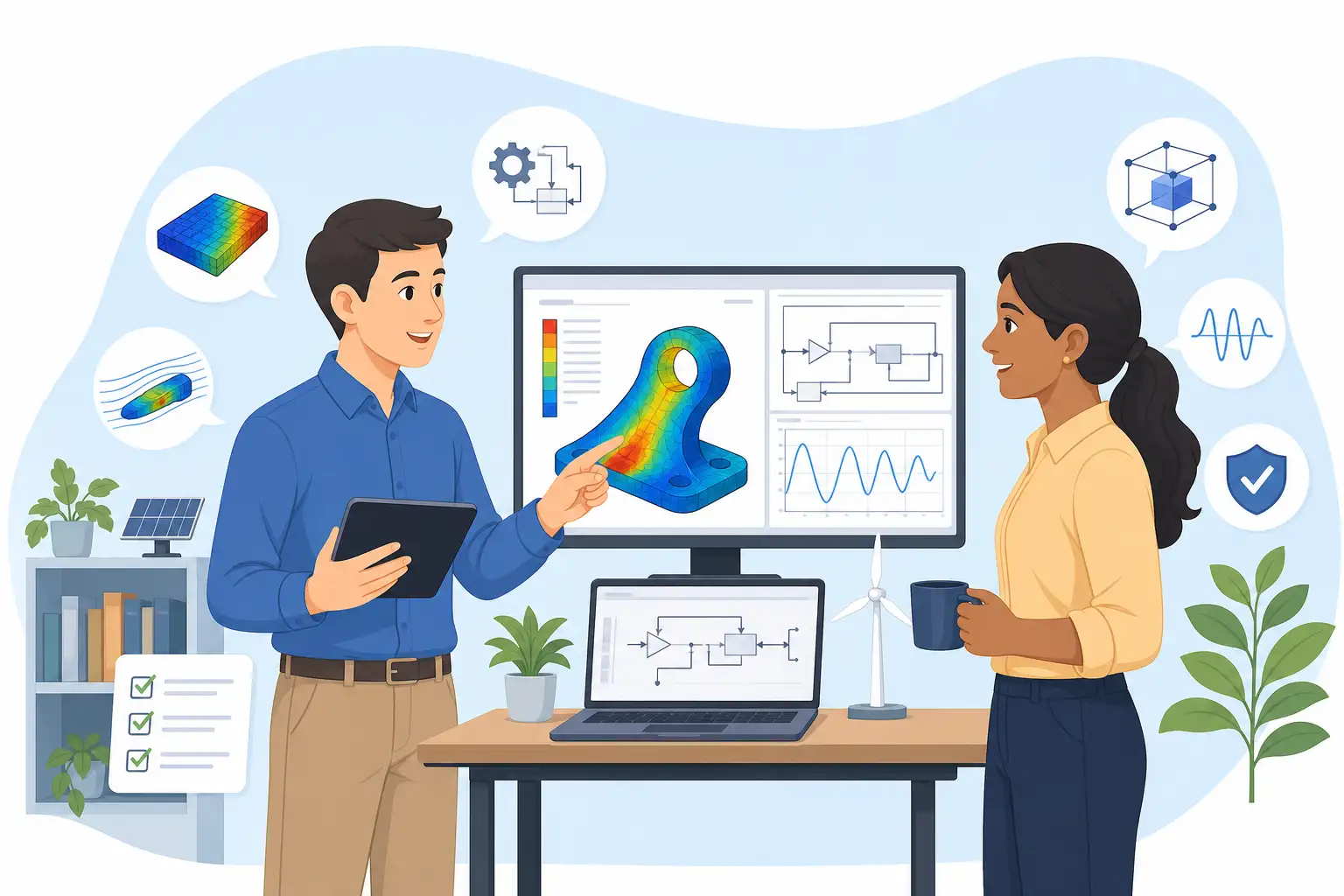
Predicts Structural, Thermal, Or Control Performance Before Building Physical Prototypes.
Sets Solver, Mesh, And Time-step Settings To Avoid Unstable Or Misleading Results.
Supports Verification And Validation With Documented Comparisons To Tests And Hand Calcs.
Automates Parameter Sweeps To Find Robust Designs Across Tolerances And Operating Ranges.

Information Technology & Software
Data Science & Artificial Intelligence
Consulting & Professional Services
Banking & Financial Services
Scientific & Research Organizations
Cybersecurity & IT Security

Data Scientist
Data Engineer
BI Developer
Machine Learning Engineer
AI Research Scientist
Software Engineer
Systems Analyst
Business Analyst
Parametric CAD/geometry Setup And Materials Property Definition.
Meshing Strategies And Solver Selection For FEA/CFD Or Dynamic Systems.
Control-system Modeling With Blocks, State-space, And Discrete-time Logic.
Verification And Validation Workflows, Including Correlation To Test Data.
Automation Of Design Studies Using Scripts, Batch Runs, And Optimization Tools.