
Produces Reserve Estimates And Forecasts That Guide Drilling Pace, Facilities Sizing, And Investment Decisions.

Reservoir engineering applies subsurface data and fluid-flow principles to estimate reserves and plan how to produce oil, gas, or water-bearing formations efficiently. It matters because sound reservoir models guide drilling and production strategies, improve recovery, and manage pressure, water cut, and environmental risk.
A professional with strong reservoir engineering can:

Build And Calibrate Reservoir Models Using Well Logs, Core, Pressure-transient Tests, PVT Data, And Production History.
Forecast Production And Reserves Under Alternative Development Scenarios, Including Decline Analysis And Simulation Runs.
Design Field Development And Enhanced Recovery Plans By Selecting Well Spacing, Lift Strategies, And Injection Schemes.
Monitor Surveillance Data To Update Models And Recommend Operational Changes Such As Choke Settings, Workovers, Or Waterflood Adjustments.
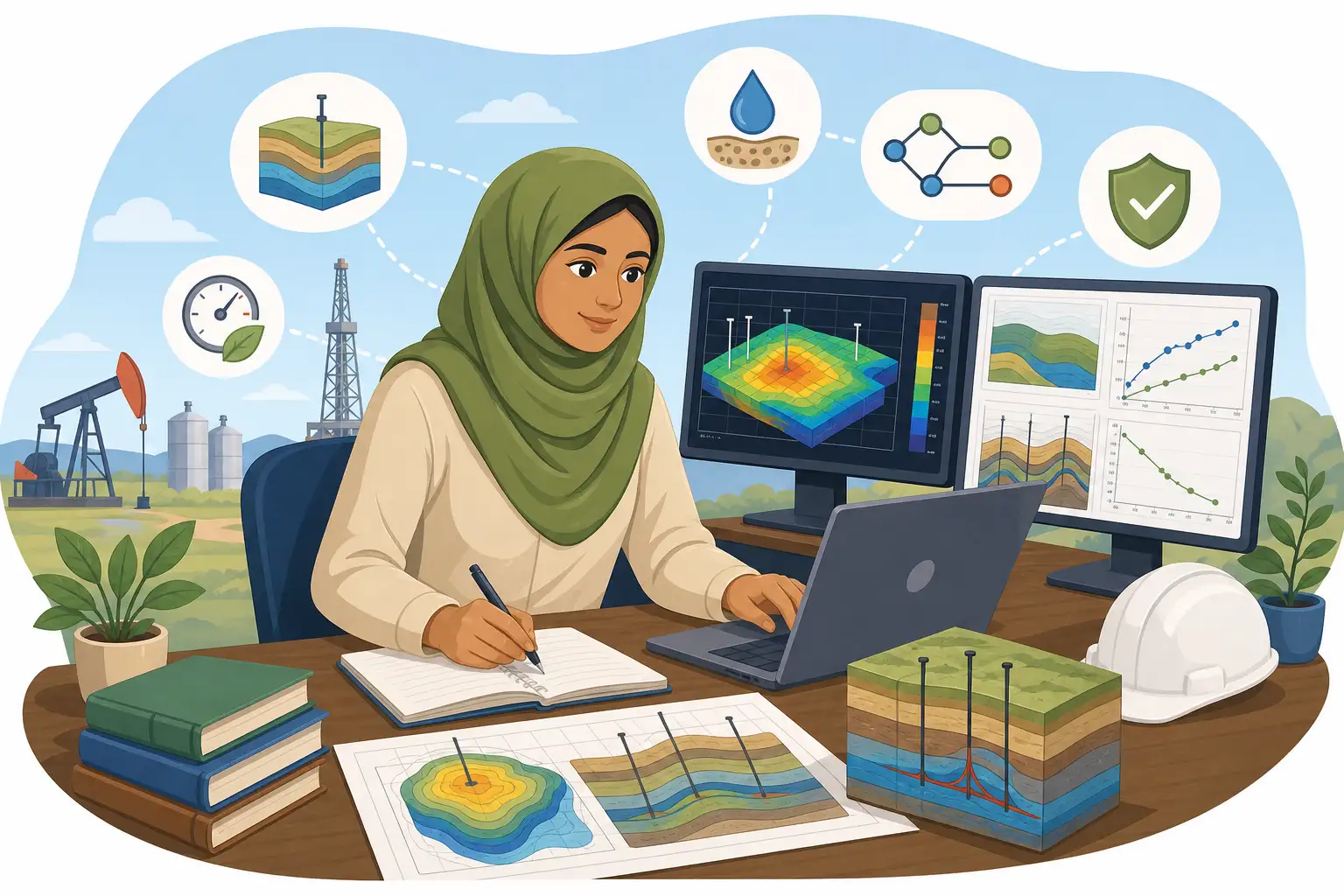
Produces Reserve Estimates And Forecasts That Guide Drilling Pace, Facilities Sizing, And Investment Decisions.
Optimizes Recovery By Selecting Well Spacing, Lift, And Injection Schemes Matched To Reservoir Behavior.
Manages Pressure, Water Cut, And Coning Risks By Updating Models With Surveillance And Production History.
Reduces Field Development Uncertainty By Integrating Logs, Cores, PVT, And Transient Tests Into Calibrated Models.

Oil & Gas (Petroleum & Natural Gas)
Chemical & Petrochemical Manufacturing
Utilities (Electric Power & Water)
Environmental Services & Waste Management
Scientific & Research Organizations
Government & Public Administration

Petroleum Engineer
Reservoir Engineer
Refinery Operations Manager
Drilling Supervisor
Chemical Engineer
Process Engineer
HSE Officer
Plant Operations Manager
Reservoir Simulation And History Matching Using Industry Software And Model Calibration Workflows.
Decline Curve Analysis And Material Balance Methods For Reserves And Performance Forecasting.
PVT And Relative Permeability Interpretation For Fluid And Rock-flow Behavior.
Well Test And Pressure-transient Analysis To Estimate Permeability, Skin, And Boundaries.
Waterflood And EOR Design Including Pattern Selection, Injection Allocation, And Sweep Diagnostics.