
Increase Throughput By Removing Bottlenecks And Balancing Cycle Time To Demand.

Process engineering is designing, analyzing, and improving workflows so they deliver consistent output with minimal waste, risk, and variation. It matters in operations and services because it turns goals into measurable process steps, improves throughput and reliability, and enables scalable performance across sites or teams.
A professional with strong process engineering can:

Map End-to-end Workflows With Inputs, Outputs, Roles, Controls, Cycle Times, And Failure Points To Establish A Baseline.
Identify Bottlenecks And Variation Drivers Using Metrics Such As Takt Time, Queue Length, Yield, And Defect Rates.
Design Process Controls (standard Work, Poka-yoke, Automation Rules, Inspection Points) To Prevent Recurrence Of Errors.
Run Pilots And Implement Improvements With Defined KPIs, Monitoring Plans, And Handoff Documentation For Sustainment.
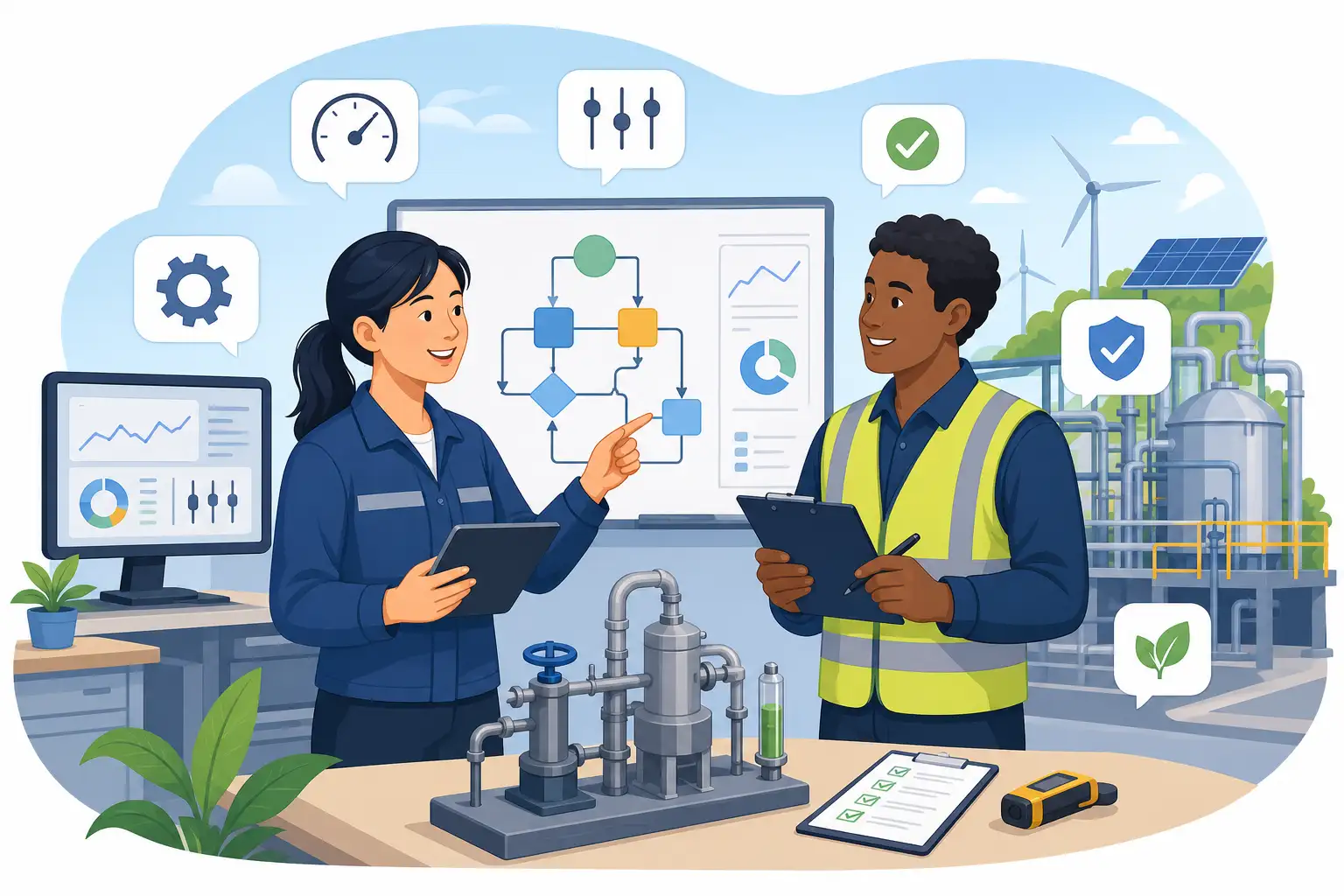
Increase Throughput By Removing Bottlenecks And Balancing Cycle Time To Demand.
Reduce Variation And Defects By Designing Controls And Mistake-proofing Into The Workflow.
Make Performance Measurable With Clear Inputs, Outputs, And KPI Definitions.
Enable Scaling Across Sites By Standardizing Steps, Roles, And Control Points.

Consulting & Professional Services
Education & Training
Government & Public Administration
Scientific & Research Organizations
Information Technology & Software
Logistics & Supply Chain Management

Business Analyst
Management Consultant
Corporate Trainer
Program Manager
Operations Manager
Process Improvement Specialist
Research Scientist
Public Administrator
Process Mapping (SIPOC, Value Stream Maps, Swimlanes).
Statistical Analysis Of Variation (SPC, Capability, Pareto).
Lean Methods For Flow And Waste Reduction (takt, Pull, WIP Limits).
Control Design (standard Work, Poka-yoke, Inspection Plans, Automation Rules).
Pilot Testing And KPI Monitoring Plans For Sustainment.