
Predicts Equipment Failures From Sensor Data To Schedule Maintenance Before Breakdowns.

Machine learning involves building and deploying models that learn from data to predict outcomes, detect anomalies, or optimize decisions in production and engineering settings. It matters because well-designed models improve reliability and quality, reduce downtime, and support standards-driven automation with measurable performance.
A professional with strong machine learning can:

Select Appropriate Algorithms And Features To Solve Classification, Regression, Forecasting, Or Anomaly-detection Problems.
Train, Validate, And Tune Models Using Robust Metrics, Cross-validation, And Error Analysis To Control Overfitting.
Deploy Models Into Manufacturing Or Utility Workflows And Monitor Drift, Accuracy, And Latency In Operation.
Document Model Assumptions, Data Lineage, And Controls To Meet Quality Requirements, Audits, And Safety Expectations.
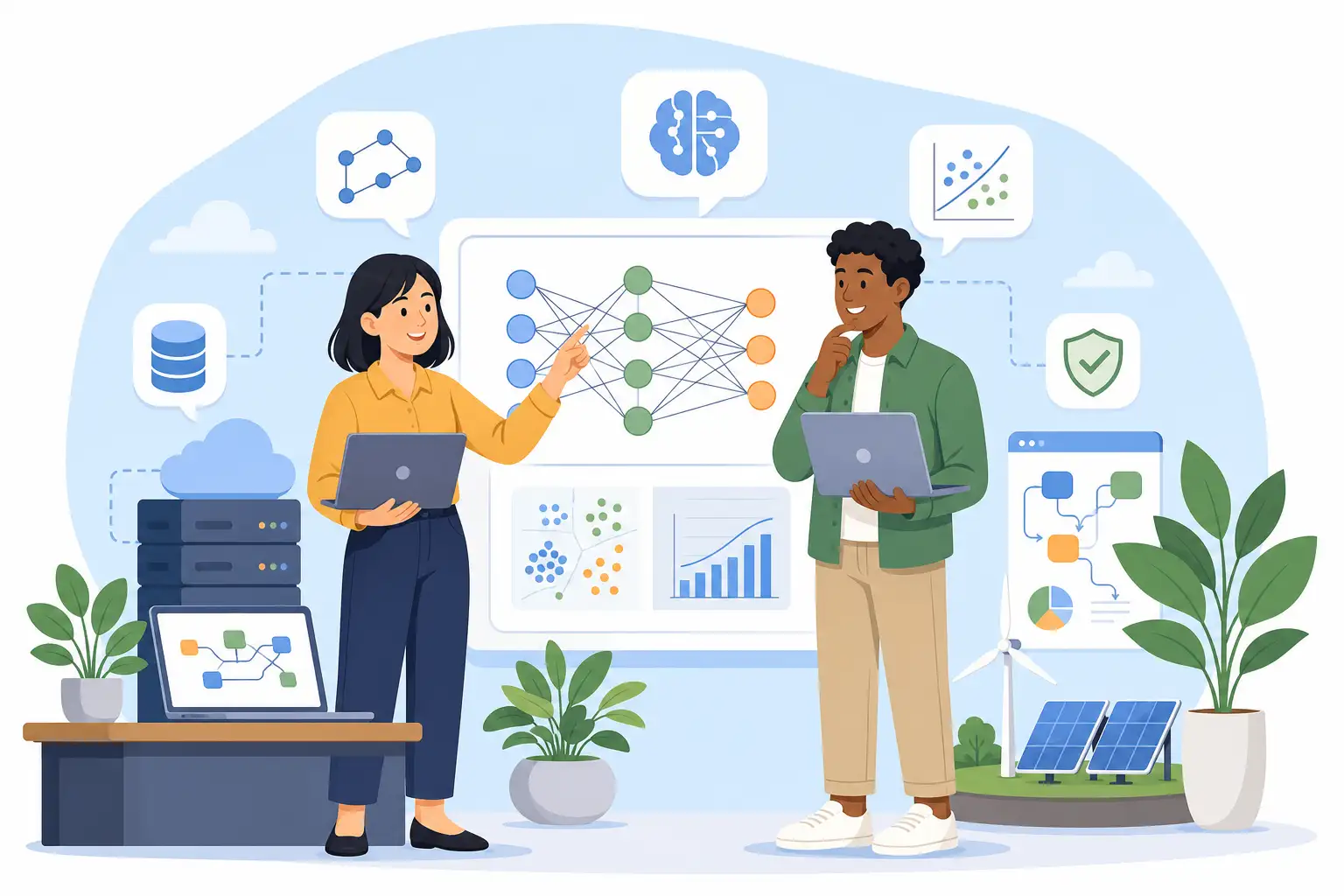
Predicts Equipment Failures From Sensor Data To Schedule Maintenance Before Breakdowns.
Flags Abnormal Process Patterns In Real Time To Prevent Scrap And Rework In Production Lines.
Optimizes Setpoints And Throughput Using Historical Runs To Raise Yield Under Constraints.
Monitors Model Drift In Deployed Systems To Keep Automated Decisions Reliable As Conditions Change.

Automotive Manufacturing
Electronics & Electrical Manufacturing
Machinery & Heavy Equipment Manufacturing
Utilities (Electric Power & Water)
Information Technology & Software
Scientific & Research Organizations

Manufacturing Engineer
Mechanical Design Engineer
Industrial Automation Engineer
Maintenance Engineer
Plant Manager
Quality Engineer
Electrical Engineer
Electronics Test Engineer
Feature Engineering For Time-series, Vibration, And Process Telemetry.
Model Training And Tuning With Cross-validation And Domain-appropriate Metrics.
MLOps Pipelines For Deployment, Versioning, And Automated Retraining.
Data Labeling And Ground-truth Collection From QA, Maintenance Logs, And Inspections.
Model Monitoring For Drift, Latency, And Alerting In Production Environments.