
Maintains Low-loss Links By Selecting The Right Fiber Type And Connector For Distance, Bandwidth, And Environment.

Fiber optics expertise involves designing, installing, testing, and troubleshooting optical cabling and components that carry data at high speed over long distances. It matters in telecom and secure networks because precise termination and validation prevent signal loss, outages, and costly service disruptions.
A professional with strong fiber optics can:

Select Appropriate Fiber Types, Connectors, And Splice Methods Based On Distance, Bandwidth, And Environment (indoor, Outdoor, Or Aerial).
Terminate And Splice Fibers To Specification, Managing Bend Radius, Cleanliness, And Cable Routing To Minimize Attenuation.
Test Links With OTDR And Power Meter/light Source, Interpreting Results To Identify Breaks, Macro-bends, And High-loss Events.
Document Fiber Routes, Patch-panel Assignments, And Test Baselines To Support Change Control, Incident Response, And Future Expansions.
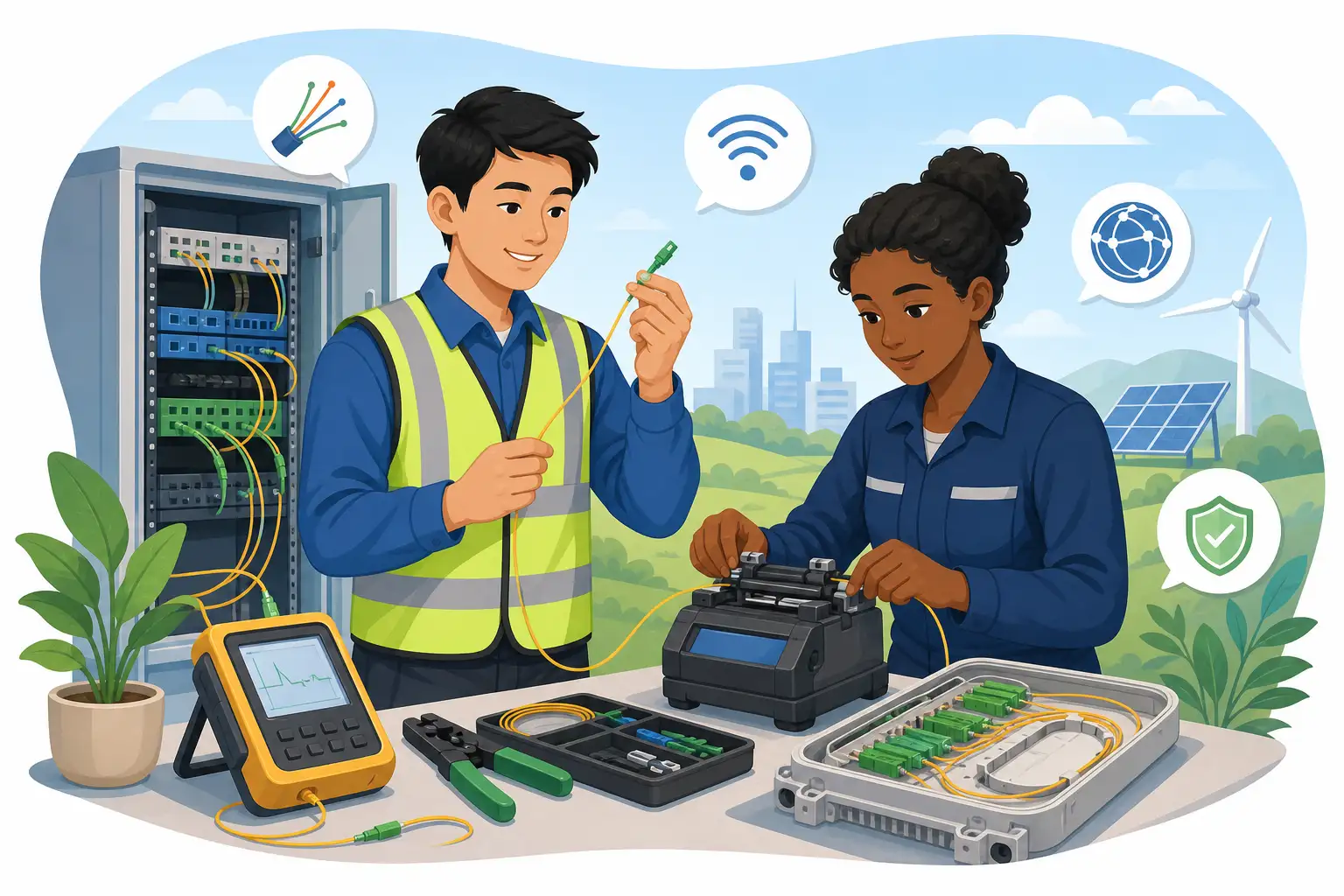
Maintains Low-loss Links By Selecting The Right Fiber Type And Connector For Distance, Bandwidth, And Environment.
Prevents Outages By Executing Clean Terminations And Splices That Control Bend Radius And Contamination.
Restores Service Faster By Interpreting OTDR Traces To Pinpoint Breaks, Macro-bends, And High-loss Events.
Supports Change Control And Expansion By Documenting Patch-panel Mappings, Routes, And Baseline Test Results.

Cybersecurity & IT Security
Information Technology & Software
Telecommunications
Data Science & Artificial Intelligence
Consulting & Professional Services
Government & Public Administration

Security Analyst
Security Engineer
Security Architect
Penetration Tester
Incident Response Manager
Network Engineer
NOC Engineer
Telecom Project Manager
Select SMF/MMF, Connector Types, And Splice Methods Based On Link Budget And Installation Conditions.
Perform Fiber Prep, Cleaving, Fusion Splicing, And Connector Termination To Manufacturer Tolerances.
Use OTDR, Power Meter/light Source, And Visual Fault Locator To Test And Certify Links.
Apply Cable Management Practices For Bend Radius, Strain Relief, Slack Storage, And Enclosure Routing.
Create As-builts Including Fiber Route Diagrams, Splice Schedules, Port Assignments, And Test Reports.