
Explains How Units Like Distillation, Cracking, And Reforming Convert Feedstocks Into Saleable Products.

Chemical & petrochemical manufacturing fundamentals cover how refineries and chemical plants convert feedstocks into products through unit operations, control systems, and safe operating limits. It matters because understanding processes, hazards, and constraints supports reliable production, quality compliance, and safe, efficient troubleshooting.
A professional with strong chemical & petrochemical manufacturing fundamentals can:

Map Major Process Units (e.g., Distillation, Cracking, Reforming, Separation) And Explain Their Inputs, Outputs, And Constraints.
Use PFDs/P&IDs And Operating Data To Trace Flows, Identify Bottlenecks, And Isolate Abnormal Conditions.
Apply Basics Of Process Safety (LOPA, Relief Systems, Flammability/toxicity) When Evaluating Operating Changes.
Define Critical Quality And Utility Requirements (steam, Cooling Water, Hydrogen) And Their Impact On Throughput And Yields.
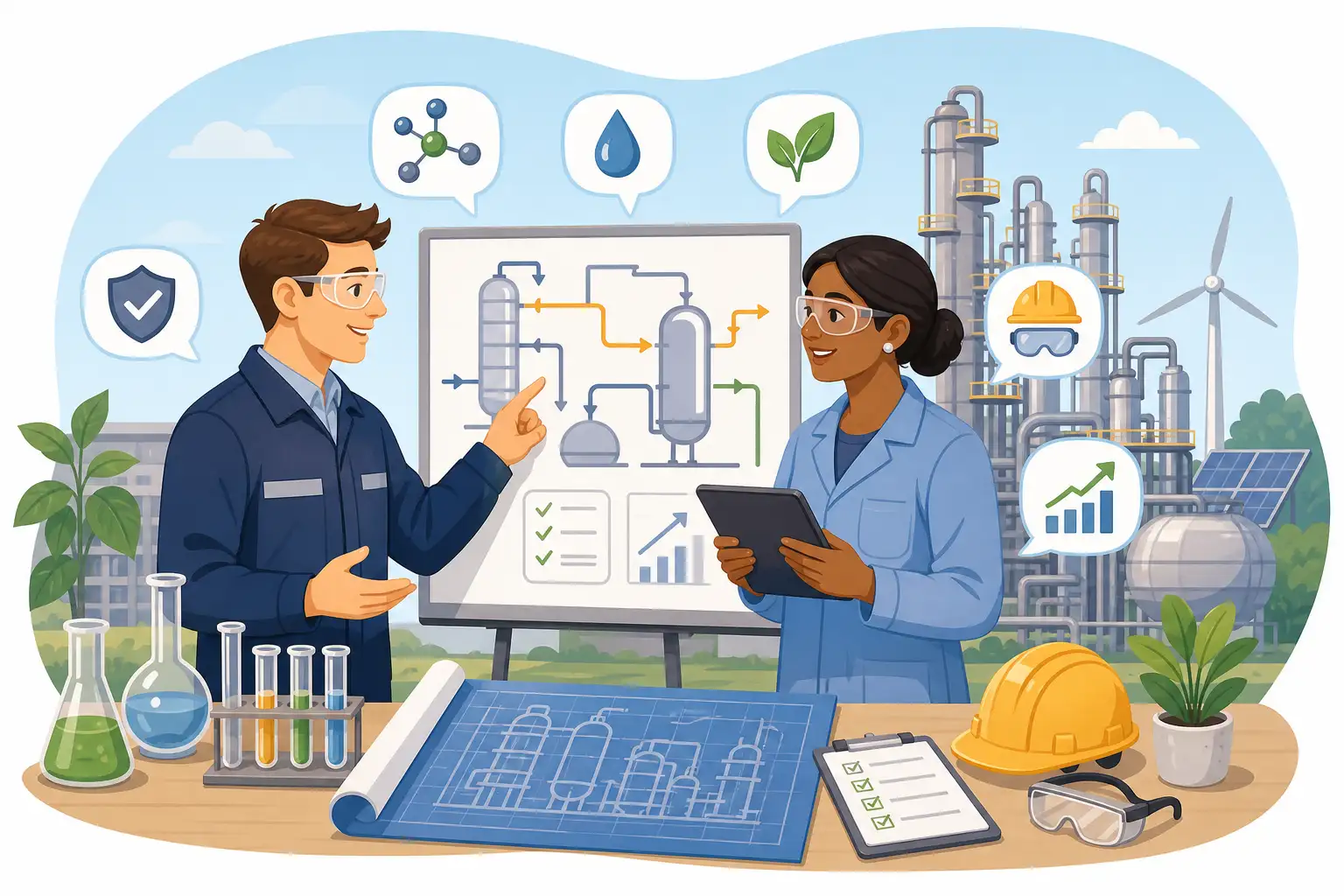
Explains How Units Like Distillation, Cracking, And Reforming Convert Feedstocks Into Saleable Products.
Uses PFDs And P&IDs To Trace Flows And Isolate Bottlenecks Or Abnormal Conditions.
Applies Process Safety Limits When Evaluating Operating Changes In Flammable Or Toxic Systems.
Connects Utility And Quality Constraints To Throughput, Yields, And On-spec Production.

Oil & Gas (Petroleum & Natural Gas)
Chemical & Petrochemical Manufacturing
Utilities (Electric Power & Water)
Environmental Services & Waste Management
Scientific & Research Organizations
Government & Public Administration

Petroleum Engineer
Reservoir Engineer
Refinery Operations Manager
Drilling Supervisor
Chemical Engineer
Process Engineer
HSE Officer
Plant Operations Manager
Unit Operations Knowledge For Separation, Reaction, Heat Transfer, And Fluid Flow.
PFD/P&ID Reading, Including Equipment Symbols, Control Loops, And Line Specs.
Process Control Fundamentals Such As PID Control, Alarms, Interlocks, And Trip Logic.
Process Safety Concepts Like LOPA, Relief Devices, SDS Hazards, And Safe Operating Envelopes.
Utilities And Offsites Understanding For Steam, Cooling Water, Hydrogen, Flare, And Waste Handling.